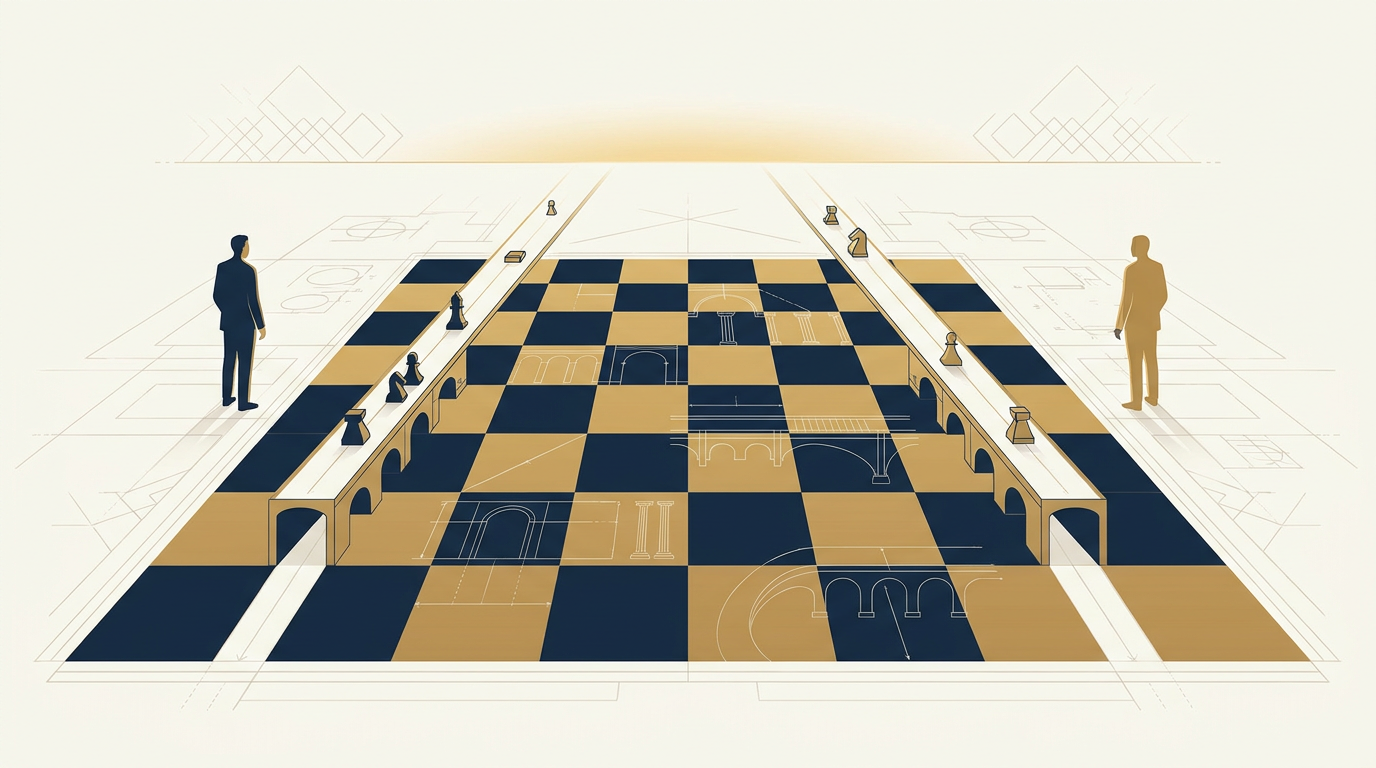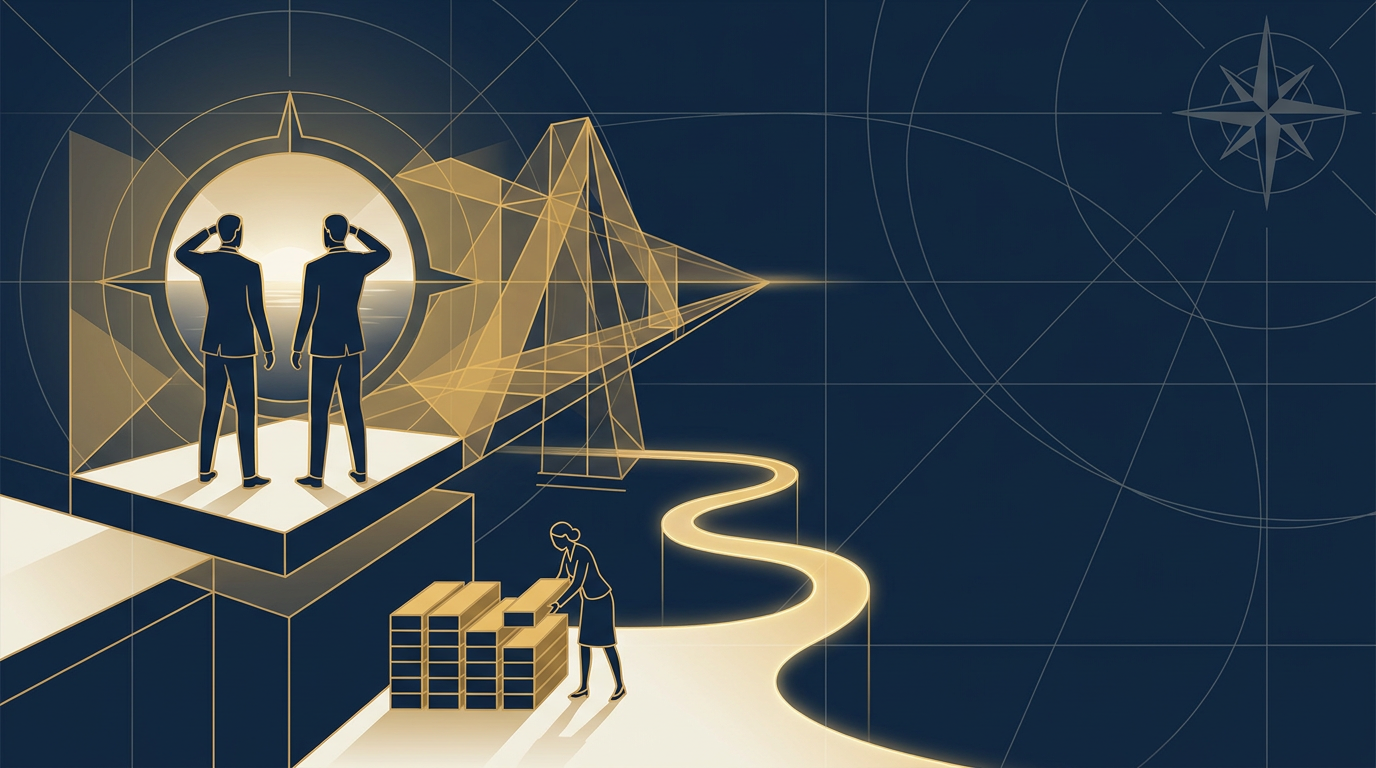
Hiring a digital twin is not delegation. It is the replication of your judgment.
An assistant executes the instructions you give it. A twin anticipates the instructions you would have given. That difference sounds small and is in fact total: you stop managing a subordinate and start calibrating a mirror. For anyone running a family office or steering enterprise strategy, deploying a first twin is less an IT project than a forced audit of how you actually decide — because a twin can only extrapolate from judgment it can see. What follows are the three decisions that define a first deployment: what the twin is, what it must never see, and when it is allowed to act on its own.
What is the difference between an assistant and a twin?
An assistant follows instructions; a twin extrapolates them. An assistant needs a defined prompt and a known process. A twin works from intent: it watches how you have decided before and proposes the next move without being asked.
The cleanest way to frame this is through dynamic-capabilities theory and the idea of the ambidextrous organization — the discipline of balancing exploitation of what you already know against exploration of what you do not. An assistant is purely exploitative: it takes a settled procedure and runs it. A twin is ambidextrous: it takes your accumulated judgment and applies it to situations you have never explicitly handled.
Picture a complex legal inquiry landing in the inbox. An assistant files it, flags it, or forwards it. A twin cross-references it against the positions you have taken before, drafts a preliminary response in your stance, and assembles the supporting documents behind it. You are not training the twin to do your work. You are training it to think about your work — which is why the hard part is rarely the technology. It is articulating a judgment process most leaders have never written down.
Why does the bubble policy matter first?
Before you decide what your twin can do, you decide what it can see. We call that boundary the bubble policy, and setting it is the first real decision in any deployment.
The instinct, especially in a family office, is to feed the twin everything — every email, every ledger, every private thread — on the theory that a faithful proxy needs total recall. That instinct is a governance failure waiting to happen. The bubble policy is the deliberate opposite: an information perimeter that names exactly which datasets the twin may query, and walls off the rest.
The boundary cuts both ways, and the tradeoff is real. Every record you exclude costs the twin context — wall off your past investment mistakes and it cannot learn from them. But the cost of over-exposure is worse, and irreversible. A twin powerful enough to surface anything on demand is also powerful enough to surface the one thing that should never have left the room, in the middle of a routine analysis. Context you can always add back later. A breach of trust you cannot.
graph TD
    A[Enterprise data lake] --> B{Bubble policy}
    B -->|excluded| C[Private family ledgers]
    B -->|excluded| D[Unverified external noise]
    B -->|allowed| E[Family-office knowledge graph]
    E --> F[Twin extrapolation]
    F --> G[Governance-aligned actions]
Think of the bubble as a one-way mirror. The twin looks outward to gather market intelligence; outside queries can never look back in. Drawing that line is not a technical chore. It is the most consequential governance decision you will make all year.
How does a twin handle a complex, multi-step workflow?
An assistant needs a straight line. If step three of five fails, it stops and waits, and the work stalls until a human notices. A twin treats the same workflow as a state machine it can reason through: when one path is blocked, it locks in what it has confirmed, adjusts, and keeps moving.
Patent prior-art search is a useful example. The naive version runs a broad keyword query and dumps the results into a folder. The twin instead weighs each result against the specific claims it is trying to defend, and ratchets forward: when a piece of prior art weakens one claim, it records that, narrows its next search to the claims still standing, and proceeds. Progress is monotonic — it never re-litigates ground it has already settled.
The same disposition shows up everywhere. Hand a twin a hostile or ambiguous web page and it treats a dead end as a routing problem, not a stop sign: find another path, keep momentum. The cost of that relentlessness is compute — continuous evaluation is not free — and that is the trade you are making, infrastructure for autonomy. A twin that halts at every broken link is not a twin. It is a script with good manners.
When should the twin answer instead of forwarding?
Let the twin answer when the cost of waiting exceeds the cost of a nuanced misstep. Forwarding protects accuracy; it also sacrifices the speed that made the twin worth deploying.
The pivotal moment in any rollout is the move from draft mode to send mode. A twin that drafts replies and leaves them in your outbox is genuinely useful, and still, fundamentally, an assistant. The capability you actually wanted arrives when it can read an inquiry, consult what it is allowed to know, compose a response in your voice, and send it. A twin that only ever drafts is an expensive spellchecker.
But autonomy without a brake is recklessness, and you do not grant full agency with a single switch. The right model is a threshold expressed in two units: financial impact and relationship sensitivity. Below the line, the twin drafts and sends. Above it — a large external commitment, or anything touching a family member or a key relationship — it drafts and routes back to you. Keep that rule as one piece of configuration you can tighten in seconds, and let every outbound action clear a gauntlet of automated checks before it leaves.
Set the threshold too high and you gain autonomy at the price of the occasional uncaught error. Set it too low and you are back inside the inbox the twin was meant to empty. Most operators settle somewhere that lets the twin handle the clear majority of routine output on its own and escalates the rest.
The real work
None of the three decisions — what the twin is, what it may see, when it may act — is technical. Each is a question about your own judgment that the twin forces you to answer out loud. That is the uncomfortable gift of a first deployment: it cannot replicate a judgment architecture you have never made explicit.
So start there. Take one decision you make on instinct, name the data behind it, and set the boundary and the threshold around it. Hiring your first twin does not begin with a model. It begins with a mirror, and the willingness to look into it.